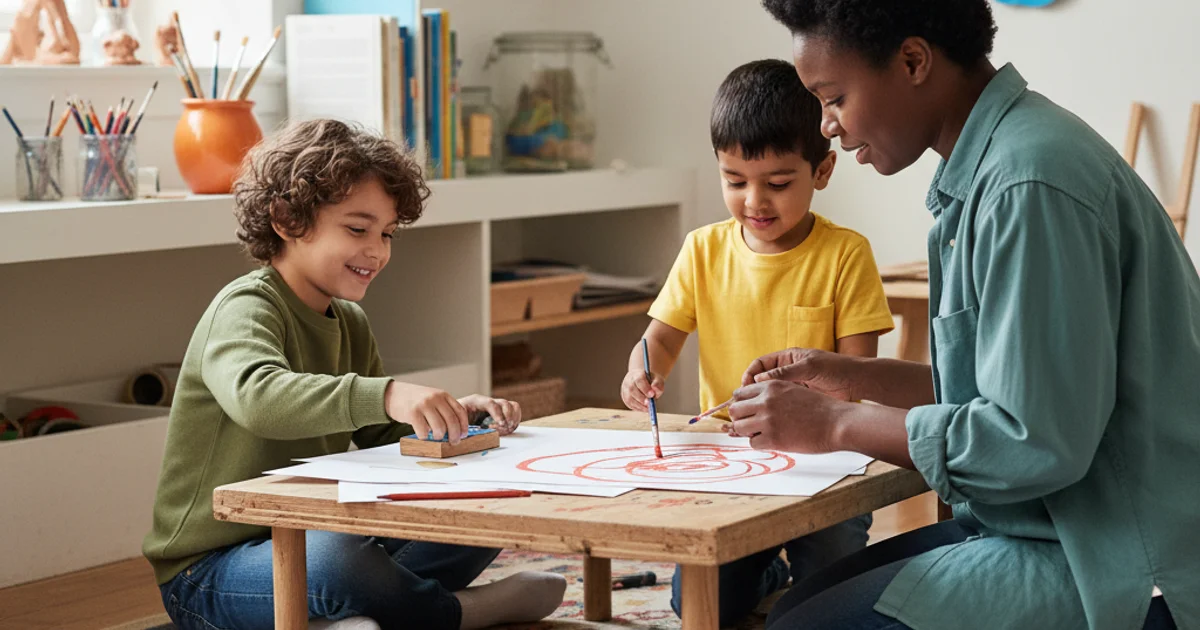
Walk into any BrightRoots classroom and you will find art everywhere — taped to walls, drying on racks, pinned to clotheslines strung across the room. Some pieces are recognizable: a family portrait, a rainbow, a cat. Others are glorious explosions of color and form that defy interpretation. All of them represent something far more important than decoration. They represent thinking, feeling, problem-solving, and growth.
In early childhood education, art is not a frill or a time-filler between real lessons. It is one of the most powerful vehicles for development available to young children, engaging their brains, their bodies, and their hearts simultaneously.
Art and the Brain
When a child creates art, they are making a constant stream of decisions. What color should I use? Where should this line go? How do I make this look like what I see in my mind? Each of these decisions engages the prefrontal cortex, the area of the brain responsible for planning, problem-solving, and executive function.
Art also develops symbolic thinking — the ability to understand that one thing can stand for another. When a child draws a circle and says "That is Mommy," they are demonstrating the same cognitive skill that underlies reading, math, and abstract reasoning. This symbolic capacity is a critical foundation for later academic learning.
Research has also shown that art activities improve spatial reasoning, the ability to understand and manipulate shapes, spaces, and relationships between objects. Spatial reasoning is essential for math, science, engineering, and many everyday tasks.
Process Over Product
At BrightRoots, we practice what educators call process art — an approach that values the experience of creating over the appearance of the finished product. This means we do not use coloring sheets, pre-drawn templates, or step-by-step craft projects that result in twenty identical pieces. Instead, we provide open-ended materials and invite children to create freely.
This approach matters because when children are told exactly what to make and how to make it, the cognitive benefits of art diminish significantly. The thinking, decision-making, and self-expression happen in the process of creating, not in reproducing someone else's vision.
When a child shows you their artwork, resist the urge to ask "What is it?" Instead, try "Tell me about your painting" or "I notice you used a lot of blue. What made you choose that color?" These responses honor the child's creative process and invite deeper reflection.
Emotional Expression and Regulation
Art provides children with a way to express feelings they may not yet have words for. A child who is angry might pound clay with force. A child who is sad might paint in dark, heavy strokes. A child who is joyful might fill an entire page with bright, swirling colors. These expressions are healthy and important.
For children who struggle with verbal communication or who are processing difficult experiences, art can serve as a safe outlet for emotions that might otherwise emerge as behavioral challenges. Many child therapists use art as a primary tool for helping young children work through anxiety, grief, and trauma.
Physical Development
Art builds the fine motor strength and coordination that children need for writing. Gripping a crayon, controlling a paintbrush, tearing paper, rolling clay, and cutting with scissors all strengthen the small muscles of the hands and fingers. These activities also develop hand-eye coordination and bilateral coordination — using both hands together in a purposeful way.
At BrightRoots, we offer a wide range of art tools and materials specifically chosen to challenge and develop fine motor skills at each stage of development.
Supporting Art at Home
You do not need expensive supplies or a dedicated art studio to support your child's creative development. Here are a few simple ideas.
Keep basic materials accessible — crayons, markers, paper, tape, glue, and scissors are enough to fuel a wealth of creative exploration. Let your child create without adult direction or correction. Display their work prominently to communicate that their creative expression is valued. Join in the process yourself — sit down and create alongside your child without worrying about the result.
Art is not about producing masterpieces. It is about the thinking, feeling, and growing that happen with every stroke, every choice, and every creation. At BrightRoots, we are proud to be a place where little artists can flourish.