
Earth Day is on Wednesday, and parents of young children sometimes feel a quiet pressure to do something big to mark it. A grand garden project. A meaningful conversation about climate change. A family pledge.
We would gently suggest the opposite. For children under five, environmental connection does not begin with concepts. It begins in the body. It begins with one ladybug walked across a small palm. With the smell of dirt after rain. With the discovery that a leaf can become a boat in a puddle. The cognitive understanding comes later. The relationship has to come first.
Here are six small, sensory-rich activities that fit easily into the rhythm of a regular week.
1. Take a "Five Senses" Walk
Pick any short walk — to the corner store, around the block, to the bus stop. Tell your child you are going on a five senses walk. Stop at a few moments and ask: What do you hear? What do you see that you have not noticed before? Can you find something soft to touch? What does the air smell like today?
That is the whole activity. It costs nothing, takes ten minutes, and reliably changes how a child experiences the route they walk every day.
2. Plant Something That Grows Fast
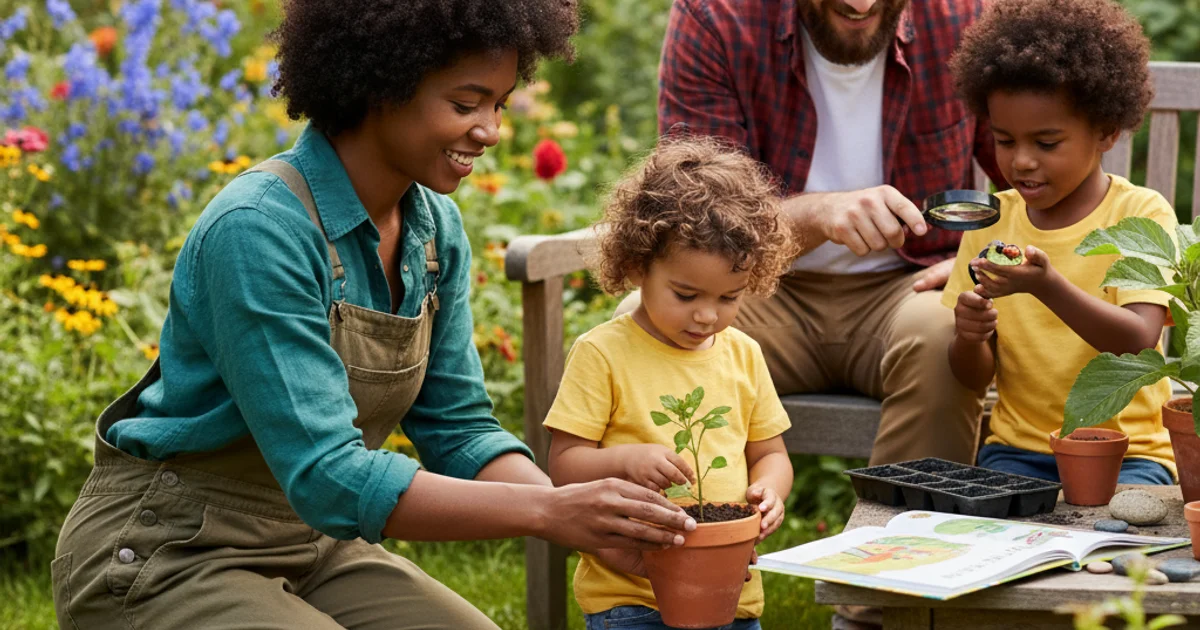
Young children's sense of time is short. A tomato plant that produces fruit in eight weeks may as well be infinite. Choose something that gives quick visible feedback: radishes sprout in three days. Beans push up a stem in less than a week. Cress will grow visibly between dinner and breakfast on a wet paper towel.
The point is not the harvest. It is the daily check, the cup of water, the small wonder that something living is responding to their care.
3. Run a "What Lives Here?" Investigation
Find a small patch of yard, planter, or park grass. Sit down with your child for ten minutes and notice what shows up. Ants, a beetle, a worm if you turn over a leaf, a spider thread, a robin watching from a branch. Count what you find. Make up names for what you do not recognize. Do not feel obligated to teach actual species names. The goal is the noticing, not the labeling.
If your child wants to draw what they saw afterwards, paper and crayons turn the experience into a memory they can return to.
4. Make a Bird Feeder Out of Whatever You Have
You do not need a kit. A pinecone rolled in nut butter and seed will work. So will a bagel half spread with the same. So will a hollowed-out half orange dangling from a string. Hang it where you can see it from a window.
Then wait. Birds may take a few days to find it. The wait is part of the lesson.
5. Save a Puddle
After the next rain, pick a puddle near your home and adopt it for the day. Visit it in the morning. Visit it after lunch. Visit it before dinner. Notice how it changes. Where did the water go? Did anything appear in it? Did the reflection look different at different times?
This is one of those activities that sounds boring on paper and is consistently magical in practice. A puddle is the entire water cycle in miniature, and a four-year-old is wired to find it fascinating.
6. Read One Beautiful Book About the Natural World
There are some children's books that change how kids see the world long after the book is closed. A few of our favorites for this age range:
- The Listening Walk by Paul Showers
- And Then It's Spring by Julie Fogliano
- Up in the Garden and Down in the Dirt by Kate Messner
- Outside Your Window: A First Book of Nature by Nicola Davies
Pick one. Read it slowly. Read it again the next day. The repetition is part of how four-year-olds make ideas their own.
What About Climate Change?
Some parents wonder whether they should be talking with young children about climate change directly. Our short answer: not yet, in most cases. Children under six do not have the cognitive scaffolding to process global, abstract, future-oriented threats, and exposure to that kind of fear can shape their relationship with the natural world in unhelpful ways.
What you can do is build the love. The understanding of what is at stake will come, in time, from their own deepening relationship with a planet they already know well. Our job in these years is to make sure that relationship gets started.
Happy Earth Day. May this week include at least one slow walk and at least one really good rock.