If you have ever watched a toddler start bouncing the moment they hear a familiar song, you have witnessed something remarkable: the human brain's deep, instinctive connection to music. Long before children can read words on a page, they can learn and remember complex melodies, rhythms, and lyrics. Music is one of the brain's first and most natural languages, and it is a powerful tool for early learning.
At BrightRoots, music and movement are not confined to a weekly music class. They are threaded through every part of the day — from morning welcome songs to transition chants to lullabies at rest time. Here is why we make music such a central part of our program.
Language and Literacy
The connection between music and language development is one of the most well-researched areas in early childhood education. Songs expose children to rich vocabulary, complex sentence structures, and the rhythmic patterns of language in a format that is naturally engaging and easy to remember.
Rhyming songs are particularly powerful. When children hear and produce rhymes, they develop phonological awareness — the ability to hear and manipulate the individual sounds in words. This skill is one of the strongest predictors of later reading success. A child who can recognize that "cat" rhymes with "hat" is building the same auditory discrimination skills they will use to decode written text.
Singing also strengthens memory. The melody acts as a scaffold that helps children retain and recall information. This is why we can all remember songs from childhood decades later, and it is why educators have long used songs to teach everything from the alphabet to the days of the week.
Motor Development and Coordination
Music naturally invites movement, and movement is essential for physical development. When children clap to a beat, march to a rhythm, or dance freely to a favorite song, they are building gross motor coordination, body awareness, balance, and spatial orientation.
Finger plays and action songs — like "Itsy Bitsy Spider" or "Head, Shoulders, Knees, and Toes" — develop fine motor skills and the ability to coordinate specific movements with auditory cues. These may seem like simple games, but they require significant cognitive and physical coordination.
For children who struggle with traditional seated activities, music and movement offer an alternative pathway to learning that honors their need to move while still building important skills.
Social and Emotional Benefits
Making music together is an inherently social activity. When children sing in a group, play instruments together, or dance in a circle, they practice listening, turn-taking, cooperation, and shared attention. They learn to synchronize their actions with others, which builds a sense of belonging and group cohesion.
Music also provides a safe outlet for emotional expression. A child can bang a drum when they are feeling energetic, sway gently to a calm melody when they need to settle, or sing a silly song when they need to laugh. Music gives children tools for managing their emotional states in a healthy, constructive way.
Music at Home
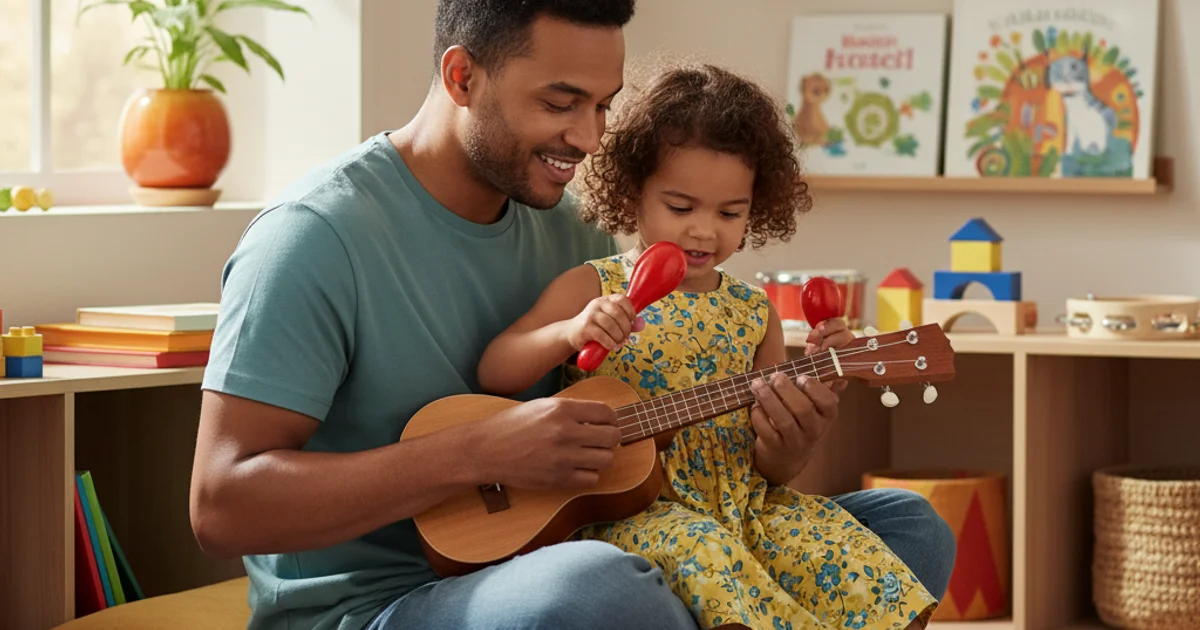
You do not need to be a musician to bring music into your child's life. Here are some easy ways to make music a regular part of your family routine.
Sing together. It does not matter if you think you cannot carry a tune. Your child does not care about pitch — they care about connection. Sing during bath time, in the car, while cooking, or as part of your bedtime routine.
Make instruments from household items. Fill a container with rice for a shaker. Bang on pots with wooden spoons. Stretch rubber bands over an open box for a makeshift guitar. Homemade instruments encourage experimentation and creativity.
Dance freely. Put on music and move. Follow your child's lead. Be silly. Dance slowly, dance fast, freeze when the music stops. These games build listening skills and body awareness while creating joy.
Explore different genres. Expose your child to a wide variety of music — folk, classical, jazz, world music, children's songs. Each genre offers different rhythmic patterns, tempos, and emotional qualities that enrich your child's musical vocabulary.
The Soundtrack of Childhood
At BrightRoots, we believe that every child deserves a childhood filled with song. Music is not a luxury or an extra — it is a fundamental building block of healthy development. So turn up the volume, grab a spoon for a microphone, and let the music play.
Want to see music and movement in action? Visit one of our classrooms or join a family event to experience the joy of making music together. Check our events page for upcoming family sing-alongs and open house dates, or contact us to schedule a tour.