
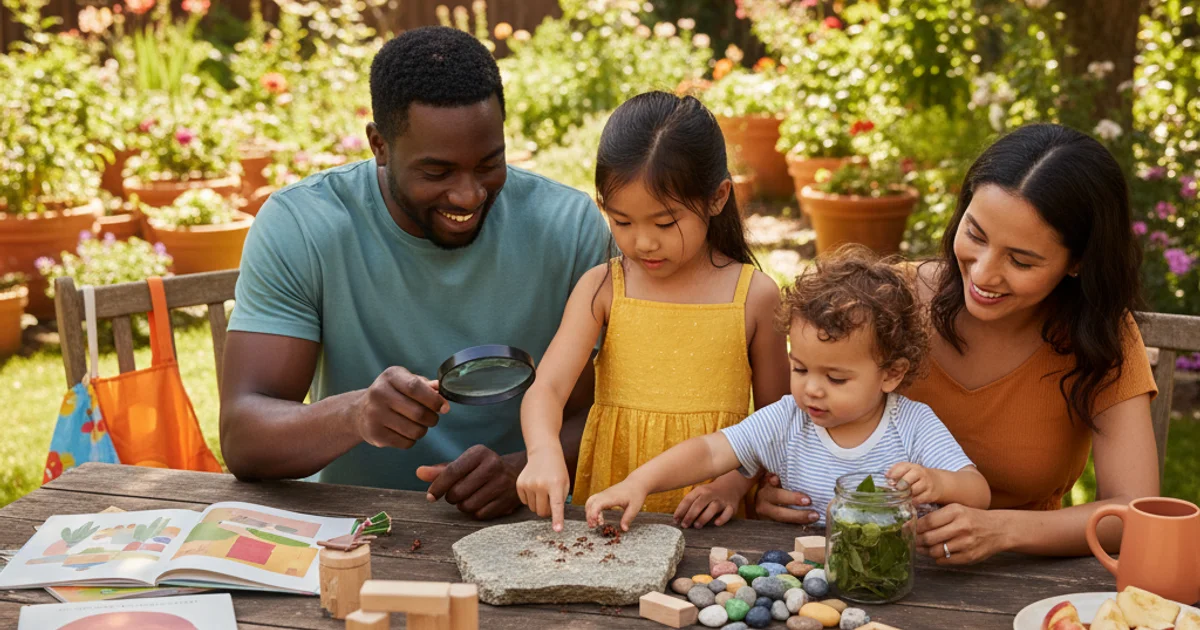
When people hear the term STEM — science, technology, engineering, and mathematics — they often picture laboratories, robots, and complex equations. It can seem like something that belongs in high school or college, far removed from the world of preschoolers. But the truth is that STEM learning begins long before formal schooling, and it starts with something every young child has in abundance: curiosity.
At BrightRoots, we do not teach STEM as a separate subject. We recognize that young children are natural scientists and engineers, constantly observing, questioning, experimenting, and building. Our role is to notice these moments, provide materials and experiences that extend them, and celebrate the thinking process that drives them.
Children Are Born Scientists
Watch any toddler for five minutes and you will see the scientific method in action. They observe their environment with intense focus. They form hypotheses — what will happen if I drop this? They conduct experiments — drop, observe, repeat. They draw conclusions — it always falls down. And then they test variations — what if I drop it from higher? What if I drop something different?
This cycle of observation, prediction, experimentation, and reflection is the foundation of all scientific thinking. Young children do not need to be taught it. They need adults who recognize it, value it, and provide the time and space for it to flourish.
STEM in Everyday Moments
STEM learning does not require special kits or expensive materials. It is embedded in the activities that fill a young child's day.
Building and construction. When children stack blocks, build with cardboard boxes, or construct a bridge for toy cars, they are engaging in engineering thinking. They are solving problems, testing designs, dealing with failure, and iterating toward solutions. Ask questions like "How can you make it taller without it falling?" to extend their thinking.
Water play. Pouring, measuring, and experimenting with water flow introduces concepts of volume, force, and cause and effect. Add funnels, tubes, and containers of different sizes and watch the investigations unfold.
Nature observation. Watching insects, examining plants, noticing weather patterns, and exploring soil are all forms of biological and earth science. Encourage children to describe what they see, make predictions, and look for patterns over time.
Cooking and baking. Measuring ingredients introduces mathematical concepts. Mixing substances demonstrates chemical changes. Following a recipe builds sequencing skills. And the transformation of raw ingredients into finished food is a delicious lesson in cause and effect.
Sorting and classifying. When children sort buttons by color, arrange sticks by length, or group animals by type, they are practicing foundational math skills. Classification is one of the earliest mathematical concepts children develop, and it underlies everything from data analysis to algebra.
The Importance of Process
In STEM education for young children, the process matters infinitely more than the product. A tower that falls down after three attempts teaches more than a tower that succeeds on the first try. A hypothesis that turns out to be wrong opens the door to deeper understanding. A failed experiment is not a failure — it is data.
At BrightRoots, we encourage children to try, fail, revise, and try again. We celebrate effort and thinking rather than correct answers. We ask questions that promote reasoning rather than recall. "What do you think will happen?" "Why do you think that happened?" "What could you try differently?" These questions are the heart of STEM education at every level.
Supporting STEM at Home
You do not need to be a scientist to support your child's STEM development. You simply need to be curious alongside them.
When your child asks a question, resist the urge to immediately provide the answer. Instead, say "That is a great question. How could we find out?" Then explore together. Look under rocks. Mix baking soda and vinegar. Build a ramp and test which objects roll fastest. Plant seeds and track their growth.
Keep a collection of open-ended materials available — blocks, boxes, tubes, tape, natural objects, containers, and simple tools. These materials invite the kind of tinkering and experimentation that builds STEM skills organically.
And above all, follow your child's interests. A child who is fascinated by dinosaurs is a child who can learn about biology, paleontology, measurement, and classification. A child who loves puddles is a child who can learn about water cycles, reflection, and states of matter. The content does not matter nearly as much as the thinking.
At BrightRoots, we are proud to nurture the tiny scientists among us. Their questions today are the discoveries of tomorrow.